
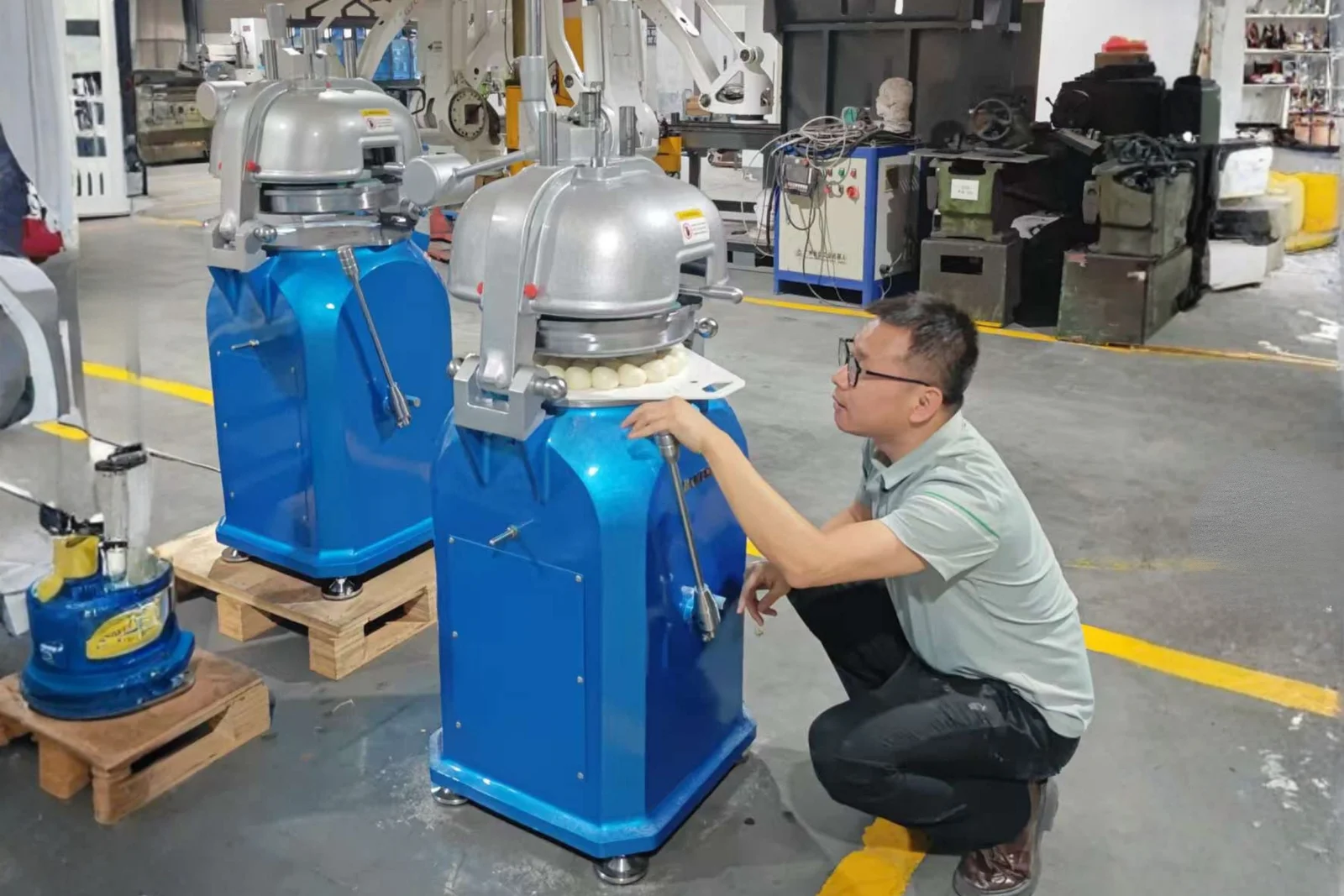
Same shape.
A different machine.
At a trade fair, two vertical semi-automatic machines stand side by side. Same red paint. Same cast-iron frame. The handle sits in the same place, and even the nameplates are the same size.
A buyer squats down, looks at both for ten minutes, then stands up with a question:
"Aren't they identical?"
They are. On the outside, this industry converged long ago. The structure has been on the market for twenty years. Anyone can copy the outline.
So we take it to the workshop.
Same batch of dough, the same 110 g piece weight. One machine runs and lays out a tray of pieces that match, each one rounded round. The other runs too. It just drifts. The last pieces in the tray are the ones that tell you, when they reach the scale.
So where is the difference?
In six workshop actions. None of them appear on a spec sheet. And not every factory has all six.
Precision is not printed on a brochure. It lives in the workshop.
1. Structure: has the market already proven it?
Start with the action chain.
The plastic plate goes into the frame, its hole lined up with the dividing block on the cutter disc. You press the pressure handle down and flatten the dough in passes. You swing the guard knife aside, press the handle all the way home, and the cutter disc turns one lump of dough into a dozen or two dozen pieces. Then you ease the handle back until the head sits about 1 mm above the rounding plate. Finally you pull the rolling lever, the plate turns, and the pieces are rolled and pressed between plate and head until each one closes into a ball.
Six or seven load points. Every one of them passes force along.
To judge whether a structure makes sense, ask one question: which part passes the motion to which? Where does the force start, which way does it travel, where does it land? A factory that can answer has designed the machine, or at least thought it through. A factory that cannot is copying.
An old structure is not a defect. This frame has been running in the market for twenty years, and we have assembled tens of thousands of machines on it. A drawing proves a machine can turn. Only time and volume prove it can turn every day.
A structure can be copied. A proven structure cannot.
So we leave the frame alone and change what sits inside it. The drive is one example. Older machines use oil seals, and oil seals leak; oil in dough is a food safety problem. We replaced that with an oil-free drive: the motor turns a slider in eccentric rotation to round the pieces. No oil seal, nothing to leak.
The industry has not touched this design in twenty years. We changed more than twenty things on it. But those changes stand on a frame the market already validated. We are not betting on an untested machine.
2. Machining: 95% of the parts come off our own tooling
Whether piece weight holds starts with the parts, not with the adjustment.
The problem with bought-in parts is not quality. It is consistency. Same part number, different batch: a little off in material, a little off in dimension. Each piece passes inspection on its own. Assemble them into one machine and that small difference shows up as piece weight drifting, noise rising, motion turning stiff.
95% of our parts come off our own tooling.
Parts from one set of tooling are the same size on the first piece and on the 5000th. That is what consistency means.
It also keeps the parts interchangeable. Three years from now, when a customer orders a cutter disc or a plastic plate, it fits, because it comes off the same tooling and not from another factory's "looks the same".
Critical mating faces are ground as well: between cutter disc and rounding plate, and between rounding plate and the top face of the base. Tight clearance keeps dough from squeezing through the gap. A flat face keeps the plate from shaking and rattling.
You can ask a factory one simple question: is this part tooled in-house, or bought in? In-house tooling means moulds, part numbers, consistency you can trace. A bought-in part comes with a supplier's certificate and nothing more.
As for the 0–3 g weighing accuracy: 5 g is considered good in this industry, 3 g is what the leading brands hold. It is not adjusted into a machine. It accumulates, part by part, until the parts agree with each other.
3. Secondary machining: tooling gives you a blank, not a part
Tooling solves "the same". It does not solve "usable".
A moulded part still has to go through secondary machining, and the work lands on the linkage: the mating face of the eccentric slider, the bores in the connecting rod, the edge of the cutter disc, the seams of welded parts.
Our own route looks like this. Every small knife on a cutter disc is deburred by hand. A burr is not just a cut finger: it traps dough and it keeps the cut from coming out clean. The round cutter disc frame is welded, then ground smooth. The rear cover plate is deburred. The critical mating faces go back onto a machine tool for grinding.
Tooling gives you the blank. People give you the part.
This is hand work. Press a little harder while deburring and the dough sticks differently. Grind a mating face a little more or a little less and clearance and noise change with it. Too little grinding and the machine runs stiff. Too much and the clearance opens up, and precision walks out the same door.
So secondary machining cannot be handed entirely to machines, and it cannot be handed to someone who has never done it.
Check it yourself: run a finger along the cutting edge, look at the weld, look at how two plates meet. Some machines in this industry have seams that sit crooked. That is not an aesthetic problem. It is assembly and secondary machining that never got finished.
4. Assembly: the engineer who has built ten thousand machines carries a list no drawing has
Assembly is not tightening bolts.
Here is the most practical test I know: does the machine run smoothly? If it does not, the problem is either a bad part or bad assembly, and usually assembly.
An engineer who has built tens of thousands of machines keeps a dozen details in his head that no drawing carries.
Where to add strength — which load point needs a shim or extra thickness, which detail looks redundant and must not be removed.
How far to turn a bolt — tight is not enough. Some points need another half turn. Some need to be brought down in stages, in order, or the base takes on stress: flat on the day it ships, warped two months later.
Where to put grease, and which grease — the head takes food-grade grease only. The rounding slide seat takes 32# oil, and the level has a floor and a ceiling. The contact face between rounding plate and the top of the base gets a film of oil, and that one film decides how loud the machine is.
Where to level — the load-bearing feet adjust. On an uneven floor a machine runs on a tilt. Precision leaves from here first, and it leaves without a warning: you simply start feeling that this batch of dough is unstable.
Where to fine-tune — the 1 mm gap between head and rounding plate, the rolling clearance scale, the belt tension.
Then there is sequence. The belt has to go in early. Lock the structure and fit the head first, and you will be taking it apart again. No drawing shows that order. No manual writes it down. Only the person who has done the rework remembers it.
An engineer who has built ten thousand machines can hear which bolt came loose. That is not mysticism. It is memory of deviation.
Ask one question: who assembles this line, and how many machines has he built? Then look at three things: is the motor earthed, is the internal wiring tidy, are the parts that rust protected. A buyer can see all three in a minute.
5. Quality control: assembly is not the end
When a machine is finished, the first thing it gets is not a crate. It gets a check.
Paint, burrs, wiring, earthing, switch feel, level, clearance, scale, noise — one by one.
When something is wrong, it goes back to the previous station. It does not get "touched up and shipped".
Because a crooked seam, grit under the paint, a bolt standing proud, a harness rubbing a moving part — these look like cosmetics. They are advance notice that something will come loose.
The real value of quality control is not catching a few bad units. It is that the people on the line know someone checks.
6. Testing: every machine runs, and only passing machines leave
This is the last station, and the most expensive one, because every machine runs.
Dry run first: listen for noise, feel for binding. Then run it with dough. Use the customer's recipe where we have it and a standard batch where we do not. Press and cut in passes. After dividing, take a stretch of continuous production, pull pieces at random, weigh them one at a time. Look at the rounding: is it round, is it off centre, is there a rub mark. Feel the controls: pressure handle, guard knife, rolling lever. Check belt tension, clean down, reset.
Spot checks mean one thing: some machines are allowed to be bad. We do not spot check. We run them one by one.
A machine that fails stays in the factory. That machine is our cost, not your rework.
7. Put the six layers together
| Layer | What we do | What is common in the industry |
|---|---|---|
| Structure | Keep a frame the market has proven for twenty years, change what is inside | Copy the outline, or drop the adjustment margin |
| Machining | 95% of parts off our own tooling, one mould one size | Bought-in parts, batch to batch variation |
| Secondary machining | Deburr every tooled part, grind the critical mating faces | Tooling straight to assembly, burrs left to feel |
| Assembly | Engineers with tens of thousands of machines behind them set clearance, level, torque | Assemble to drawing, ship |
| Quality control | Every unit, every item; problems return to the previous station | A look at the outside |
| Testing | Every unit run with dough, pieces weighed one by one | A dry spin, or a spot check |
None of these six lines is high technology on its own. The hard part is all six at once.
Copying the outline of a machine takes three months. Getting all six lines in place takes tooling, veteran hands, people who have built ten thousand machines, and a factory that will not let a single detail go.
That is why so many machines look the same and feel completely different — and the longer you run them, the wider the gap.
One more thing: what this machine does not do.
0–3 g is the accuracy band of the equipment. It is not a promise for every dough and every piece weight. Water content, flour, fat, room temperature, the operator's hands: any one of them moves that number.
A Semi-Automatic Dough Divider & Rounder (Vertical) also handles only part of the recipe range. Dough that is too hard or too sticky is not a fit.
Accuracy is the result of repeated tests, not one lucky run. When you come for a trial, test it several times and weigh several pieces.
If you have a recipe you are unsure about, send it to us or bring it in. We will run a stretch of continuous production on your dough, sample at random, weigh piece by piece, and send you the results.
Message Robert on WhatsApp and I will send you footage of a machine running.